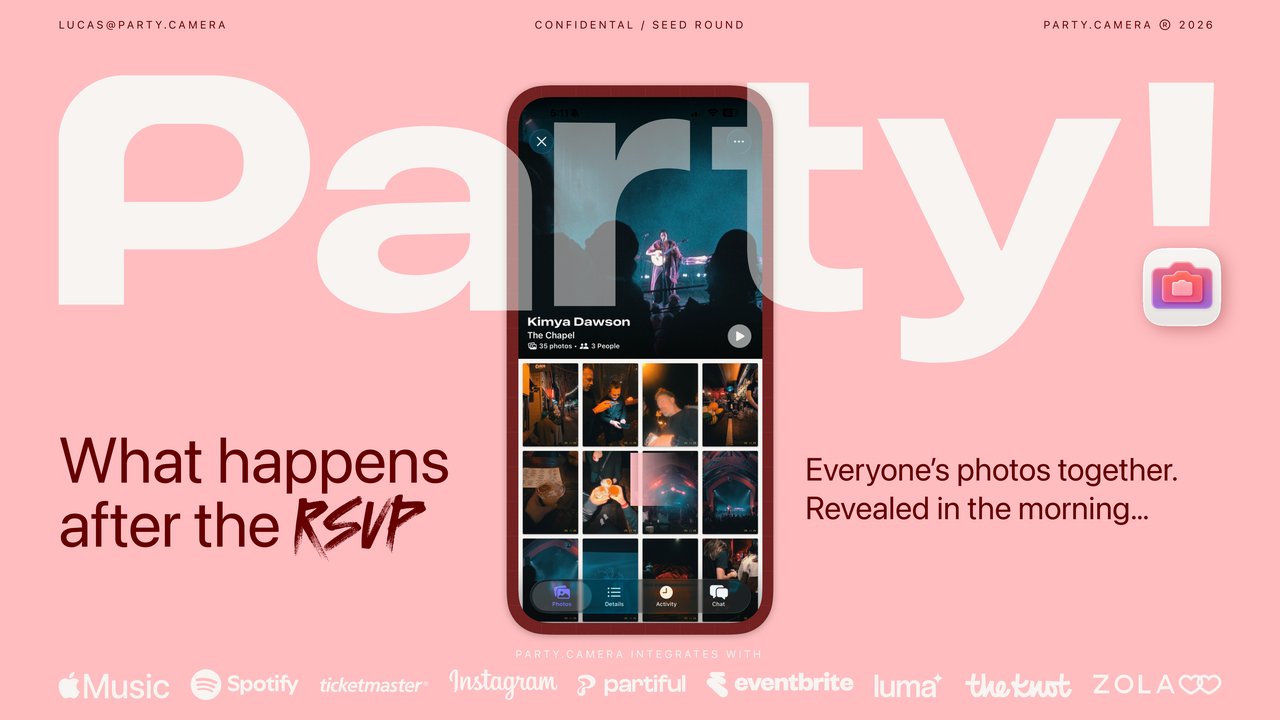
The shared camera for what happens after the RSVP.
One camera. The whole room. One reveal. No feed. No followers. Closed by design.
 View deck ↓
- Hipstamatic founders. Apple App of the Year. 70M+ downloads. 15 years of iOS camera and distribution credibility. The team that defined mobile film photography is shipping the next chapter.
- The moment. Gen Z is walking away from permanent feeds — 435M TikTok views on #disposablecamera alone. Meta just forced Instagram to ship "Instants" (a Locket clone) this week. It landed badly. Meta sees the shift; they can't host it. We named the category in a 2024 thesis paper.
- 18 months. Zero marketing. 4.0M impressions, 41K downloads, 12.8K cameras, 217K photos. Apple App of the Day twice (July 2025, March 2026), unprompted.
- The flywheel works. 59.8 photos per social event. 62.4% wedding pay rate. 7.8% guest-to-host with zero re-engagement. The data proves the thesis — we just had to unblock the funnel.
- Shipping at velocity. Six releases in six months. Apr 21–30: 5→35 free-tier cap, Partiful/Evite/Apple Invites paste, Reveal share rail to Snap/WhatsApp/TikTok. Today (v2.2.3): The Knot wedding-website integration — direct line into the 62%-paying wedding tier — plus system Share Extension, Siri, Shortcuts, and Spotlight. Cohort data measuring now.
- Raising $3M. Post-money SAFE, $15M cap, YC standard form. Funds the remaining fixes, the CoreML Reveal moat, the 4M Hipstamatic email reactivation, and 18 months of runway to a Series A on K > 1.0 sustained.
Eighteen months. Word of mouth. Apple App of the Day twice. The flywheel works.
Party.Camera is a shared group camera for what happens after the RSVP. The host creates a camera in 60 seconds. Guests join by tapping a link — no install (iOS App Clip). Everyone contributes to one shared roll. The next morning, the full collection unlocks for every participant at once. No feed. No followers. Closed by design.
It's the first product in a category I named in a 2024 thesis paper: disposable networks. Ephemeral, event-based social products that exist while the moment is alive and dissolve when it ends. The opposite of Instagram's permanent graph. The space Meta and Snap structurally cannot build.
We launched September 2024 with zero marketing, zero partnerships, zero PR. Eighteen months in: 4.0M App Store impressions, 41K downloads, 217K photos across 12,800 events. Word of mouth alone. When the right group finds it, they shoot deeply — 59.8 photos per social event, 62.4% pay rate at weddings, 7.8% guest-to-host with zero re-engagement.
The product works. The flywheel was throttled by one product decision: a 5-guest free-tier cap that held average social cameras to 1.6 participants. Between April 21 and April 30, 2026, we shipped the structural fix: the cap is gone (v2.1), Partiful / Evite / Apple Invites paste integration is live (v2.2), and Reveal shares to Snapchat / WhatsApp / TikTok (v2.2.1). Nine days. Three releases. The flywheel went from blocked to live.
The biggest shift in consumer social since Facebook. We named it. Meta just validated it.
For 20 years, consumer social has built variations on one model: permanent feeds, public graphs, ad-supported reach. That model is ending. Gen Z lives in private group chats, real disposable cameras (435M TikTok views on #disposablecamera alone), film, vinyl, dumb phones, ephemeral content. The defining trend of the next decade in consumer social is the digital recreation of how humans gathered before Facebook — and Party.Camera is the first product built for it from the ground up.
The behavioral signal Meta just gave us
On May 12, 2026, Meta forced the Instagram team to ship "Instants" — a clone of Locket, the friends-only photo widget. The reviews are scathing. The reason Meta shipped it anyway is the real story: Instagram is hemorrhaging Gen Z engagement to ephemeral, group-first, anti-feed products. Meta sees the behavior shift. They're trying to bolt it onto a business model that fundamentally can't host it. We were built for this shift from day one — and we don't have a permanent feed to protect.
Disposable networks — the offline pattern, restored
In a 2024 thesis paper — The Rise of Disposable Networks — I named the category Party.Camera is the first product in. A disposable network is born when the moment begins and dissolved when it ends. For 40,000 years that is how humans actually socialized: in groups, in real life, with photos that lived inside the event — developed at the lab, passed around at the dinner the week after, put in an album, forgotten. The permanent social graph is a 20-year experiment. Disposable networks are forty thousand years of human pattern. The pendulum is swinging back, and the next consumer social platform of consequence will be built on it.
A feed company structurally cannot ship the answer
Snap, Meta, TikTok — every feed-based company is trapped by their own model. A product that dissolves itself when the event ends is architecturally hostile to a permanent graph and an ad-supported feed. Instagram Instants is the proof: Meta has unlimited engineering, and the best they can ship is a bolt-on clone of an existing widget. The teams that will build this category are the ones who don't need a permanent graph to survive. We've been the focused indie team in this lane for 15 years.
Apple is telling our story. The platform is finally ready.
On July 4, 2025, Apple featured us as App of the Day. 1.44M impressions in 30 days, 14× the prior month. In March 2026 they recycled the story under "Apps We Love" — a second unpaid editorial lift nine months later, framed in the near-verbatim language of my 2024 thesis paper.
The technical stack is also finally complete. App Clips for zero-install join. On-device CoreML for the morning reel. UIPasteControl for native invite integration. All shipped by Apple in the last 24 months. The behavior, the audience, the platform, and the editorial signal all arrived in the same 24-month window. We're the only team built for it.
Party.Camera isn't a social network. It's the unowned slot in the event timeline.
This product started as Hipstamatic D-Series in 2011 — the first shared disposable camera on iOS, 2M users in its first month. We rebuilt it as DSPO in 2016. The unlock came on iteration three: the product we were trying to build was never a social network. It's a different shape of company entirely — one that sits in the unowned slot of the event-tech timeline.
The event tech stack already exists. There's one slot nobody filled.
Every dollar ever spent on an event ends up as a photo. Nobody runs the camera. That's the slot we picked.
This is the trojan horse
Own the camera in the room, and two things happen mechanically.
Pre-event platforms integrate with us, not around us. Every host on Partiful, The Knot, Eventbrite, Apple Invites, or Evite asks the same question: "where's the camera for our event?" We just shipped paste/share integration with all of them (Partiful · Evite · Apple Invites v2.2 April 25, The Knot v2.2.3 today). No coordination required. They benefit from the better post-RSVP product for their hosts; we anchor in their hosts' flow.
Post-event platforms consume our content. Every Reveal shared to Snapchat, WhatsApp, TikTok (v2.2.1 April 30) is an unpaid impression for Party.Camera inside feeds we don't compete with. They get the content their algorithms need; we get the distribution we'd otherwise pay for.
If we own the "during," we don't have to win the pre-event or post-event categories. We become the natural integration point for both. That's the company.
Sixty seconds to create. One tap to join. Nothing to install.
The host creates a camera, names it after the night, picks a film stock from the Hipstamatic library, sets a reveal time. Guests join by scanning a QR or tapping a link — no app install (iOS App Clip). Everyone contributes to one shared roll. At reveal, the full collection unlocks for every participant at once.
Shipped
- iOS app, App Store Featured
- App Clip — 10-second join, zero install
- 15 film stocks from Hipstamatic library
- Live participant count, timed or manual reveal
- Flipbook auto-generation
- Partiful / Evite / Apple Invites paste v2.2
- Reveal share to Snapchat / WhatsApp / TikTok v2.2.1
- Public Parties for Live Music — LA beta v2.0
- Party! Club subscription — $19.99/yr live
Product signal
- 59.8 avg photos per social camera
- 97.7% of social cameras have ≥1 photo
- 62.4% wedding pay rate · 28.1% birthday
- 88% download → signup activation
- Day-1 re-open > 40% on active events
- $6.42 LTV for hosts with 4–9 events
- 4.8 stars, 230 ratings
The pre-fix 77.4% solo-camera rate was an invite-step failure, not a product failure. When a camera gets a second participant, engagement is extraordinary. The fix is mechanical, not experiential. The paste-flow half shipped April 25 (v2.2). The native creation-flow fix ships in the first 60 days of the seed window.
When a real group finds it, they use it deeply. Weddings convert at 62%.
Everything below came from word of mouth, App Store organic, and one unpaid Apple editorial. 18 months. Zero marketing spend.
Payment behavior by event type
The wedding cohort isn't a rounding error. It's the shape of a Series A vertical.
| Event Type | Pay Rate | Avg Photos | Signal |
|---|---|---|---|
| Wedding | 62.4% | 102 | Series A vertical · $99 event package fits |
| Birthday | 28.1% | 71 | Core consumer · the subscription ICP |
| Event (generic) | 25.8% | 74 | Untapped depth across the long tail |
| Holiday | 22.0% | 63 | December was our best organic month |
| Friends | 18.3% | 52 | Volume driver · invite-funnel sensitive |
| Night out | 16.0% | 44 | Venue play · already happening organically |
Baseline data Jun 2024 – Mar 2026. Post-fix cohort metrics (Apr 21 onward) measuring now; first-cohort numbers queued for the seed pitch. Full KPI detail and historical charts on the Analytics page. Anonymized host/guest graph on the Network page.
From $254 a month to $600K ARR in 12 months. Here's the mechanism.
The projection isn't a slide. It's a chain of five inputs, each grounded in numbers we already have. The arrow that climbs from $254/month (Q1 2026 baseline) to $600K ARR (12-month target) is the sum of these five.
The K-factor frame
- K baseline ≈ 0.3 — pre-fix, flywheel starved by the 5-guest cap
- K per Reveal share ≈ 0.45 — modeled from existing guest-to-host data
- K target 0.7–1.0 — 6.75× modeled lift now measuring on the post-Apr-21 cohort
- Self-sustaining threshold: K ≥ 1.0
- Flywheel closes at: ≥ 8 guests/camera (social avg 12.5 today)
- Series A milestone: K ≥ 1.0 sustained over 90+ days
Three problems suppressing K. We just shipped fixes for two. The third ships on the seed.
Six releases in six months. Apr 21–30 was a nine-day sprint that shipped the structural flywheel fixes the data made obvious. Today (May 15) we shipped v2.2.3 — The Knot wedding-website integration, the system Share Extension, Siri, Shortcuts, and Spotlight. The flywheel features are live and compounding; the pace is accelerating.
Free Tier Rework — cap removed · subscription live
Basic cameras now support 35 participants (was 5). The single largest mechanical constraint on K-factor is gone. Party! Club annual subscription ($19.99) is live alongside per-camera Deluxe ($2/$5/$10), Premium ($49/$99), Party! Pass ($1), and Camera Roll Boost ($2).
Invite Integration — Partiful · Evite · Apple Invites · The Knot · system share sheet
Users pasting an event URL get a Party.Camera auto-attached to the invite list. The system Share Extension (v2.2.3, today) extends this to any iOS app sharing an event URL. The Knot wedding-website auto-attach also ships today — direct distribution into the highest-converting vertical we have (62.4% wedding pay rate). Modeled impact across the paste/share flow: 3× social camera rate.
Morning Reveal — share rail · CoreML moat post-seed
FlipBook video shares into Snapchat, WhatsApp, and TikTok. Every Reveal lands on the platforms that drive organic acquisition. Feed-style photo viewing, iOS 26 liquid glass design, and host Photos Preview moderation round out the post-event experience.
Six releases. Six months. Velocity is the proof.
No paid acquisition until post-fix K-factor is verified over 60+ days of clean cohort data. The bucket is sealed mechanically — now we measure before we pour.
No formal Partiful / Luma partnership pitch — the paste integration shipped without their permission. We approach from demonstrated attach rate.
No wedding vertical push pre-seed — weddings already convert at 62.4% organically. The dedicated wedding product is a Series A play.
No new camera features. The camera works. The growth mechanics needed sealing — and now they are.
Monetise behavior, not intent. The multi-SKU IAP architecture is live.
Baseline LTV is $0.18/download against a $2–5 benchmark for comparable apps. That gap is architectural, not behavioral. The old model asked for a fee before users felt value. The new architecture is in production and ranges from a $1 Party! Pass to a $99 Premium Max Camera, with the $19.99/year Party! Club anchoring the recurring tier. The next lever — in-event IAP at the 100-photo cap — is the post-seed engineering trigger.
Live today
- Free tier — 35 guests, Flipbook included v2.1
- Party! Club — $19.99/year subscription live
- Deluxe Camera — $2 / $5 / $10 per-camera
- Premium / Premium Max — $49 / $99 event upgrades
- Party! Pass — $1 entry-tier unlock
- Camera Roll Boost — $2 photo capacity add-on
Series A (12 months out)
- In-event IAP at photo cap — peak-excitement trigger
- Wedding packages — $99 event, 62.4% pay rate already established
- Venue plan — $149/mo white-label for bars, restaurants, clubs
- Festival licensing — $2,500–$25,000 per event
- Live music labels via the LA Public Parties beachhead
- Platform API — Partiful, Eventbrite paid integration
Projections
| Horizon | Paying Subs | ARR (Subs) | Blended ARR | Driver |
|---|---|---|---|---|
| Today | ~120 repeat payers | <$1K | — | Multi-SKU IAP + Party! Club just live |
| +12 mo (Seed) | 700 | $42K | $600K+ | Native invite + Hipstamatic email + full Reveal |
| +24 mo (Post-A) | 3,500 | $210K | $3.0M | + 50 venues, wedding vertical, festivals |
Beyond the table, the path to $10M ARR is unit-economic, not TAM-spread: ~200K active hosts × $4.99/mo + 5K weddings/yr × $99 + 500 venues × $149/mo. We're at 12.8K cameras and 121 repeat payers today — and one Apple-driven viral month (1.44M impressions, July 2025) already showed the product travels. The flywheel we just unblocked is the bridge from here to there.
Organic first. Paid never before K ≥ 1.0 verified.
Shipped (Apr 2026)
- Free-tier cap 5 → 35 v2.1
- Partiful / Evite / Apple Invites paste v2.2
- Reveal share to Snapchat / WhatsApp / TikTok v2.2.1
- Party! Club $19.99/yr subscription live
- Public Parties LA beta (Dec 2025) v2.0
First 90 days of seed
- Native ContactPicker invite-at-creation Q3
- Guest-to-host day-7 push Q3
- Hipstamatic 4M email reactivation — same week as native fix
- App Store Optimization overhaul
- Wedding cohort case studies
Q4 2026 — Expansion
- Full CoreML morning reel ships Q3–Q4
- Public Parties expansion — NYC + 2 cities
- Campus ambassador program, 5 markets
- Paid UA tests at $10–$15 CPI — only after K ≥ 1.0 verified
- Android beta engineering kicks off
Q1 2027 — Series A prep
- Wedding, venue, label BD conversations begin
- Series A close target: 12–15 months post-seed
- Android beta in market
- 4-city Public Parties footprint live
The team that defined mobile film photography is shipping the next chapter.
Lucas Buick — CEO
Founded Hipstamatic in 2009 — the original iPhone photography app. Apple App of the Year. 70M+ downloads. Established the aesthetic language of mobile photography before Instagram existed. 15 years of iOS distribution credibility and platform relationships. Shipped D-Series in 2011, DSPO in 2016, and published The Rise of Disposable Networks in 2024 — the thesis paper this company is built on.
Ryan Dorshorst — CTO
Co-founder. 15+ years building iOS camera products at Hipstamatic. CoreML, VisionKit, App Clips, on-device video rendering. The technical architecture behind Party.Camera — on-device AI, zero-install App Clip, local video rendering — is Ryan's. The product that works this well with zero marketing is his work.
Party.Camera, Inc. is a new Delaware C-Corp spinning out of Hipstamatic LLC. Product, IP, and team are contributed to the new entity. Investors in this round invest into the standalone company.
$3M. $15M post. YC SAFE. Series A in 12–15 months on K > 1.0.
Terms
Ownership at cap
| Check | Implied % |
|---|---|
| $100K | 0.67% |
| $250K | 1.67% |
| $500K | 3.33% |
| $1M | 6.67% |
Use of funds
Engineering — full CoreML Reveal, native ContactPicker, in-event IAP, Android beta, 2 hires. Growth — Hipstamatic 4M reactivation, Public Parties NYC + 2 cities, wedding-tier BD, holiday 2026 campaigns. Ops — founder salaries, legal (incl. BIPA clearance), infrastructure scale.
Series A trigger
Eight quantitative gates, two structural. Target close: 12–15 months post-seed (mid-2027).
- K ≥ 1.0 sustained over 90+ days
- Guest-to-host ≥ 12% (from 7.8%)
- Solo-camera rate ≤ 35% (from 77.4%)
- Avg participants/camera ≥ 8 (from 1.6)
- MRR ≥ $50K ($600K ARR pace)
- D30 host retention ≥ 50%
- Full CoreML Reveal live · Android beta
- Public Parties in 4 cities (LA + NYC + 2)
Plus structural: Hipstamatic 4M email reactivation campaign run with measured results.